
Table of Contents
- What Is Machine Learning?
- Types of Learning: A Brief Overview
- What Does Machine Learning Do in Spend Management?
- 1. Category Learning: From Receipt to the Right Expense Line
- 2. Duplicate Detection: The Same Receipt Cannot Be Entered Twice
- 3. Anomaly Flagging: Catching the Unusual Automatically
- 4. Forecasting: Anticipating Budget and Cash Flow
- What Does It Mean for Finance Teams?
- Machine Learning at Masraff
- Conclusion
From voice assistants to product recommendations, machine learning technologies are at work in many corners of everyday life. But for finance teams, the real question is this: What does this technology concretely do in a company's expense and spend processes? Who classifies the piles of receipts, who catches duplicate entries, who forecasts next quarter's budget?
In this guide, we briefly summarize the core concepts of machine learning and then shift the main focus to spend management: category learning, duplicate detection, anomaly flagging, and forecasting.
What Is Machine Learning?
Machine learning is a subfield of artificial intelligence that enables computer systems to learn from data without being explicitly programmed and to improve their performance with experience. In traditional software, the developer writes the rules one by one; in machine learning, the system discovers patterns from the examples it is given and builds its own rules.
Arthur Samuel of Stanford University defined the field in 1959 as follows: "The field of study that gives computers the ability to learn without being explicitly programmed." The definition still holds today. At its core, there are three components: data (the raw information to learn from), the algorithm (the method that extracts the pattern), and the model (the structure that can produce predictions after training).
Types of Learning: A Brief Overview
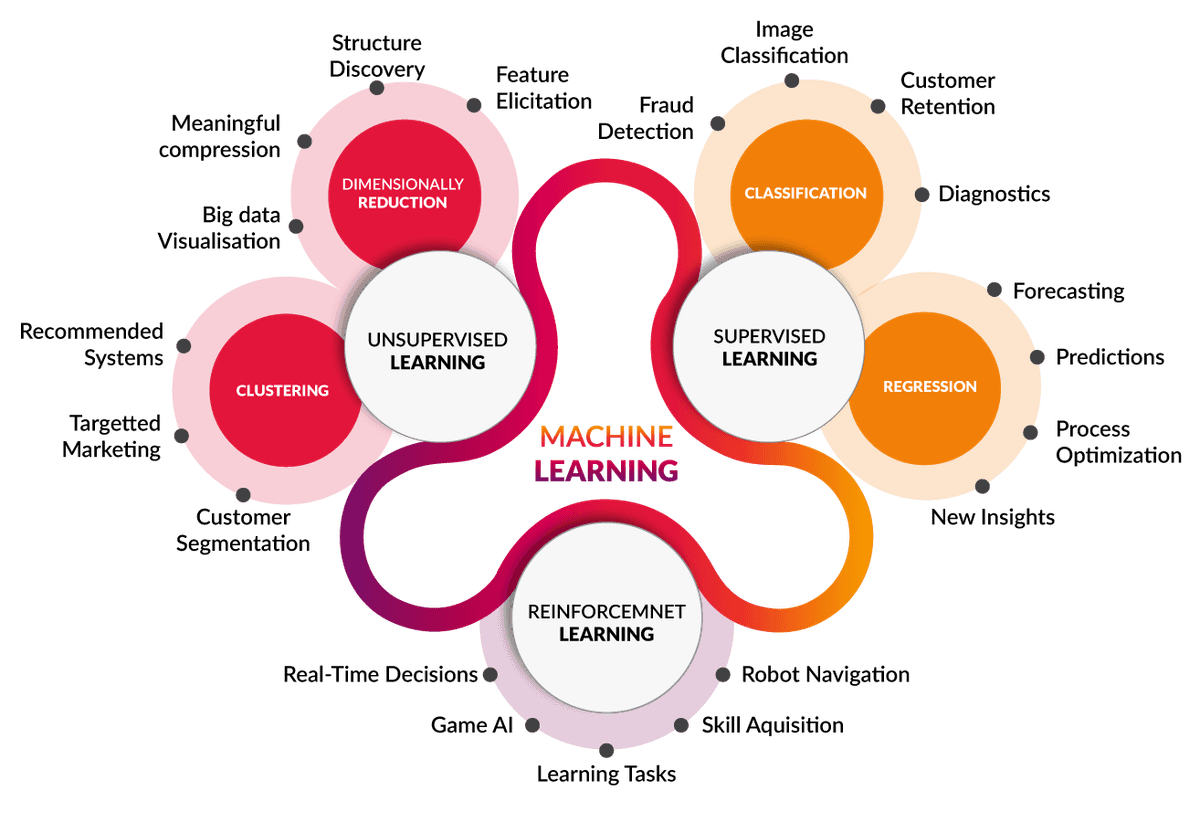
Machine learning is divided into three main approaches. Thinking of each with a spend management example makes the concepts concrete:
- Supervised learning: The model is trained on labeled examples where the correct answer is known. A model that has seen which expense category thousands of receipts belong to learns to classify a new receipt on its own.
- Unsupervised learning: The model discovers hidden groups and patterns in unlabeled data by itself. It extracts clusters of "normal" behavior in the company's spend data; a transaction that falls outside the cluster draws attention.
- Reinforcement learning: The system learns, through trial and error, the strategy that maximizes reward. It stands out in areas like robotics and games rather than day-to-day finance operations.
Deep theory is not the subject of this article; the real question is how these approaches are put to work in expense processes.
What Does Machine Learning Do in Spend Management?
A company produces hundreds of receipts, invoices, and expense lines every month. Processing this volume by hand is both slow and error-prone; expense entry carries a hidden time cost for the company. This is exactly where machine learning takes on four core jobs.
1. Category Learning: From Receipt to the Right Expense Line
The most common counterpart of supervised learning in spend management is automatic categorization. Starting from fields such as vendor name, amount, date, and description, the model predicts which category an expense belongs to — meals, transportation, accommodation, or entertainment.
What is critical here is that the model learns in a company-specific way. The same vendor may be "client entertainment" in one company and "team meal" in another. When the finance team makes a correction, the model learns from this feedback; over time the need for corrections decreases and accounting records become consistent with the chart of accounts.
2. Duplicate Detection: The Same Receipt Cannot Be Entered Twice
Submitting the same receipt twice is most often absent-mindedness rather than bad intent; but the result in both cases is the company paying extra. Rule-based checks only catch records that are exactly identical. Machine learning, on the other hand, works on similarity: it scores the likelihood that two entries with the same amount, a date shifted by one day, and a differently spelled vendor name are the same expense, and sends the suspicious pair for review.
This capability is also the first line of defense in deliberate fraud scenarios. For the policy and culture side of the topic, see our article on expense fraud.
3. Anomaly Flagging: Catching the Unusual Automatically
The field counterpart of unsupervised learning is anomaly detection. The model learns "usual" behavior from the company's historical spend data by department, period, and employee, and automatically flags transactions that deviate from this pattern:
- A spend amount noticeably above the usual range,
- Unusual entries concentrated on weekends or outside working hours,
- A suddenly rising spend frequency in one category,
- Records that keep coming very close to expense policy limits.
As a result, instead of checking every line one by one, the finance team focuses only on flagged exceptions; audit effort decreases while policy compliance strengthens.
4. Forecasting: Anticipating Budget and Cash Flow
Historical spend data is used not only for retrospective reporting but also for forward-looking prediction. Regression-based models evaluate seasonality, growth trends, and department behavior together to forecast the expense level of the coming period.
These forecasts are directly useful in two areas: in budget management, setting realistic targets and spotting in-period deviations early; and in cash flow planning, managing liquidity correctly by knowing the upcoming payment load in advance.
What Does It Mean for Finance Teams?
The common outcome of these four capabilities is this: manual data entry and line-by-line checking decrease, and the finance team's time shifts to exception management and analysis. Closing processes speed up, the consistency of accounting records increases, and policy violations are caught before payment is made. Machine learning here is not a technology fad but an infrastructure that lets the expense operation scale.
Machine Learning at Masraff
Masraff places the capabilities described in this article at the center of its expense management product:
- Receipt and invoice recognition: Vendor, amount, date, and tax information are extracted automatically from a photo of the receipt; the employee does not enter data by hand.
- Category learning: Expenses are automatically classified according to the company's chart of accounts; as the team makes corrections, the model adapts to the company.
- Duplicate and anomaly control: Similar entries and out-of-policy or unusual expenses are automatically flagged in the approval flow.
- Spend visibility: Data accumulated by category, department, and period forms the basis for budget and cash planning.
Conclusion
Machine learning is a broad field described with concepts such as supervised, unsupervised, and reinforcement learning. From a business perspective, its value emerges not in abstract definitions but in concrete processes: the receipt going to the right category by itself, the duplicate entry being caught before payment, the unusual expense being flagged instantly, and the coming period becoming predictable.
To see these capabilities in your spend processes, you can explore Masraff's expense management solution and get in touch with us for an evaluation tailored to your team.