
Table of Contents
- What is deep learning?
- Where does deep learning touch the business?
- 1. Document and receipt reading: optical character recognition
- 2. Classification: booking the expense to the right place
- 3. Forecasting: anticipating budget and cash flow
- What is the difference between deep learning and classical machine learning?
- What should you watch out for when deploying it in the enterprise?
- Frequently Asked Questions
- Are deep learning and artificial intelligence the same thing?
- How is deep learning used in corporate expense management?
- Do we need to train our own model to benefit from this technology?
- How much data does a model need?
- Conclusion: bring deep learning into your expense process
Deep learning is a machine learning approach based on multi-layer artificial neural networks inspired by the nerve cells in the human brain. In this article we will briefly summarize what deep learning is, and then focus on the real question: where does this technology touch a company's day-to-day finance and expense processes? Reading receipts and invoices, classifying expenses, and budget forecasting are the three main areas where deep learning lands concretely on the finance team's desk.
What is deep learning?
Unlike classical machine learning, deep learning uses artificial neural networks made up of many layers. The word "deep" refers to the large number of these layers. The first layers capture simple cues in the data (lines in a receipt image, character strokes), while the deeper layers learn more abstract concepts (this is a total amount, that is a vendor name).
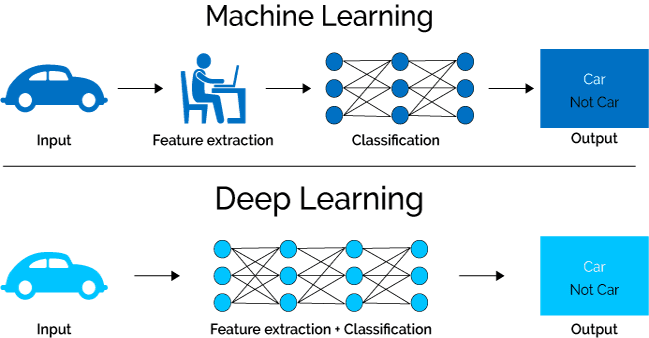
The real difference is this: in traditional methods, an expert manually defines which features of the data to look at. Deep learning, on the other hand, takes raw data directly and discovers on its own what matters. This capability provides a major advantage with data that does not fit into a tidy table, such as images, audio, and free-form text. The crumpled receipts, invoices in varying formats, and description texts that pass through an accounting team's hands every day are exactly this kind of data.
The neural network's learning process also follows an intuitive logic: the model makes a prediction, the error between the prediction and the actual value is measured, and the network's internal settings are updated in the direction that reduces this error. After thousands of iterations, the model becomes increasingly accurate at, for example, reading the amount on a receipt.
Where does deep learning touch the business?
The architectural details of deep learning (convolutional networks for image data, recurrent networks and attention-based models for sequential data) are a matter for technical teams. What matters to a finance leader is which jobs these architectures take over. Let's look at three main examples.
1. Document and receipt reading: optical character recognition
The place where deep learning touches corporate finance most directly is document reading. Optical character recognition technology can recognize different typefaces, handwriting, and even text on crumpled or low-quality receipts with high accuracy. Modern systems do not just read characters; they understand the document's structure, parse tables, and separate the date, amount, tax rate, and vendor information into fields.
What this means for the finance team is clear: manually entering the receipts and invoices collected by employees is both slow and error-prone. Deep learning–based document reading cuts this step down to seconds; it reduces lost receipts, incorrect amounts, and late submissions at the source. We covered the burden of manual entry on the company in detail in our article on the hidden time cost of expense entry.
2. Classification: booking the expense to the right place
Deep learning's second big area of work is classification. Assigning an expense to the "meals", "transport", or "accommodation" category seems simple; but doing this manually and consistently across thousands of expense lines is hard. Models that learn from text and images automatically suggest the right category and the right cost center for an expense by looking at the receipt content, the vendor name, and the amount.
Accurate classification is not just a matter of tidiness: category-level visibility makes it possible to automatically enforce expense policy rules. An out-of-policy expense reaches the manager already flagged at the approval stage.
An extension of the same classification infrastructure is anomaly detection: because the model has learned the usual spending pattern, it can flag cases such as duplicate receipts, inflated amounts, or unusual vendors. We examined the process side of this topic in detail in our article on expense fraud.
3. Forecasting: anticipating budget and cash flow
The third area is forecasting. Deep learning models that work with sequential data are used to predict the coming period's expense trajectory from historical spending series. This feeds directly into two core jobs of the finance team: on the budget management side, spotting end-of-period variances early; on the cash flow side, planning the coming months' outflows more accurately.
It is important to set expectations correctly here: forecasting models do not give exact figures; they give trends and ranges. And that is precisely where their value lies — they shrink the surprise and bring the decision forward.
What is the difference between deep learning and classical machine learning?
The two concepts are often confused; through a business lens, the differences can be summarized as follows:
| Feature | Classical machine learning | Deep learning |
|---|---|---|
| Feature extraction | Defined manually by an expert | The model learns it from the data itself |
| Data requirements | Can work with less data | Requires large datasets |
| Suitable data types | Structured tabular data | Unstructured data such as images, text, audio |
| Explainability | Decisions are easier to trace | The rationale behind decisions is more opaque |
Deep learning is a subset of machine learning. For unstructured-data tasks such as reading receipt images, deep learning is clearly superior; for small and structured datasets, classical methods can still be effective and more economical.
What should you watch out for when deploying it in the enterprise?
When bringing deep learning into finance processes, three points deserve attention:
- Data quality: A model is only as good as the data that feeds it. A system built on messy, poorly labeled expense data will not inspire trust; data discipline must come first.
- Explainability: In audit-prone areas like finance, "the model said so" is not a sufficient justification. Setups where automated decisions (for example, flagging an expense) are combined with human approval should be preferred.
- Build-or-buy decision: Training your own model requires data, specialized hardware, and an expert team. For most businesses, the right path is to use a spend management solution that provides document reading and classification out of the box, and to build your own model only if there is a genuinely differentiating need.
Frequently Asked Questions
Are deep learning and artificial intelligence the same thing?
No. Artificial intelligence is the broadest concept; machine learning is one of its subfields, and deep learning is a subset of machine learning.
How is deep learning used in corporate expense management?
In three main ways: automatic reading of receipts and invoices via optical character recognition, automatic classification of expenses into categories and cost centers, and budget and cash flow forecasting from historical data. Anomaly detection (flagging duplicate or out-of-policy expenses) comes on top of these.
Do we need to train our own model to benefit from this technology?
In most cases, no. Document reading and expense classification are areas where off-the-shelf solutions have matured; training your own model requires major investments in data and expertise, and generally makes sense only for very specific needs.
How much data does a model need?
It depends on the problem. A few thousand examples may suffice for simple classification tasks; complex image and language tasks require far more. Transfer learning, which builds on pre-trained models, makes it possible to get good results even with little data.
Conclusion: bring deep learning into your expense process
Deep learning has moved beyond academic curiosity and entered the finance team's everyday toolkit. Document reading eliminates manual entry, classification automates policy enforcement, and forecasting brings budget and cash planning forward. Masraff digitizes your receipts and invoices in seconds with artificial intelligence-powered document reading technology, automatically classifies your expenses, and manages your expense process end to end. Get in touch with us to see what can be done with your own spend data.